
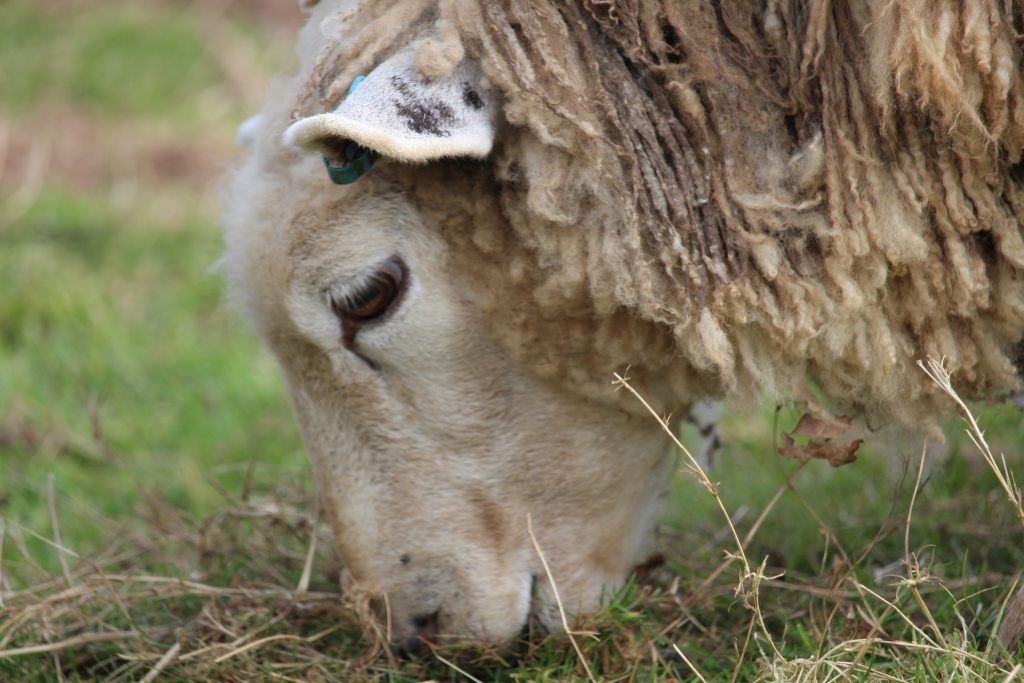
Shortly after we had transitioned from an amateur small holding mentality to that of a professional sanctuary one, I noticed one day that Candy wasn’t as buoyant and free spirited as she normally was. Although late summer the weather had been unreliable with warm sunny days being mixed readily with cold, wet, depressing ones. So I put Candy’s behaviour down to a dislike of the weather and nothing more.
The following day, the other two ewes were acting perfectly normally but still Candy was decidedly off colour in her disposition, and I noted that her fleece was beginning to look dirty and forlorn.
‘I’m a bit concerned about Candy,’ I said to Kelly that evening when she came back from work, ‘she seems depressed and is keeping to herself, I just have a feeling things are not right. And her fleece is looking dirty, not like Flossie’s at all.’
We went down to look at all three in their paddock. Ebby was meandering round searching out tasty blades of grass, as was Flossie, Candy however was stood alone by the hay rack listlessly nudging at stalks.
‘She’s not right is she?’ Kelly agreed.
‘No, I’m getting a bit worried, she was fine and then just started to not look right, and I don’t understand why she’s looking so dirty.’ I answered.
I had, at this point done a lot of ‘learning’ but there is nothing that is a substitute to experience. There will be those reading this now that will be screaming out what poor Candy was suffering from, but with my inexperienced eyes it just hadn’t registered.
The following morning Candy was missing.
The ewes didn’t have a huge paddock, it was big enough but it was square and there weren’t many blind spots, nevertheless I couldn’t see Candy. Initially I was confused, then I started to feel a rise of panic. As you do in these situations you ask those present whether they knew where the missing one is, but neither Ebby or Flossie were of any use or even much interested in my question. I stood and visually scanned the space. Nothing. So, I started to walk down to their shelters to see if they were hiding her, as I did so I suddenly noticed a dark shape lying at the side of their hay rack (this is a low level sheep hay rack on wheels rather than one fixed to a fence or wall). It was immediately obvious to me that this was my lost sheep. I stepped up my pace and headed straight for her.
She looked dreadful. Pitiful. Her head was down in the mud and my first instinct was that if she was not dead, she was not far from it.
‘Candy, Candy my love, come on, what’s wrong sweetheart?’ I begged her as she raised her head forlornly. Her eyes exuded misery but as I stooped down to her she valiantly attempted to show spirit and began to raise herself from the ground.
‘Come on darling, what’s wrong?’ I put my hand on her head and ran it over her fleece. She looked dreadful and her fleece was dirty and smelly and damp which seemed extraordinary as her two companions looked absolutely fine. Then I noticed that we weren’t alone. Flies were buzzing around us ferociously. Big bodied, ugly, green bodied flies. They were everywhere. Then finally all that studying I had done kicked in. My heart sank, my stomach turned over and I knew that I had missed the tell-tale signs and had failed this beautiful girl.
I straddled the sheep and began to search her fleece, knowing what I would find but hoping that I wouldn’t.
It didn’t take long. She was riddled.
As soon as I saw one I saw hundreds. Wriggling tiny white maggots deep in her fleece. My first reaction was to suppress a retch, my second was to dig further. I separated the wool where I saw the maggots and got down to the skin. There the infestation was horrific. Maggots were pouring out of her whilst attempting at the same time to dig their way deeper into her flesh. I was suddenly saturated by a confusing mixture of thoughts and emotions. Compassion and guilt were at the forefront, then an overwhelming feeling of drowning in a situation that was well out of my depth.
I have often felt out of my depth. In fact frequently I feel out of my comfort zone. It is something clearly in my psyche that makes me feel unprepared, incapable or unqualified for the situation I have found myself in. A situation I have inevitably brought upon myself. Many performers will admit to an imposter syndrome, that belief that the façade that we believe we hide behind will be pulled away revealing the reality that we are talentless and unskilled. We do earnestly believe that we are imposters, but paradoxically we also do believe in ourselves and hope that the truth is never fully discovered.
My imposter syndrome was at the fore in that moment. The harsh voice of criticism and anger from my own head filled my ears.
‘Who did I think I was to take responsibility for these defenceless creatures?’
‘What arrogance to believe that I could act as guardian.’
‘What utter hubris I presented.’
The self-criticism was loud and forceful and withering but in the same moment I gathered my thoughts together, ignored the self-doubt and pulled myself together, despite my acknowledged deficiencies I was the only one in that moment that could do anything to help this poor sheep.
I gently eased myself off Candy’s back, my brain desperately working to formulate a plan of action that I could administer on my own. Candy hardly reacted at all. The misery she was experiencing and must have been experiencing for some days had taken her spirit. Without my legs acting as some support to her she slumped to the ground in abject defeat.
The truth was that I did know what to do and I had all the tools to carry out and attempt to complete my task. On our shelves and in our cupboards in the garage we have a large selection of sprays, powders, salves, ointments, dressings and the like in anticipation of just such situations. I raced back to the house as quickly as my unfit body would allow and threw open the door to the garage. All our medical ‘goodies’ are in a family heirloom of Kelly’s, a delightful turn of the (20th) century drinks cabinet that was her father’s mother’s.
I grabbed the basket we keep all essential tools such as scissors, scalpels and hoof cutters in along with a selection of dressings and took from the cabinet all the sprays and tins and bottles I felt I might need, including two bottles of methylated spirits. Then turned on my heels and with my chest heaving raced, or stumbled, back down to the stricken ewe.
She hadn’t moved. Her head was flat on the ground in front of her, she could quite easily have been dead.
‘Come on lovely,’ I tried to encourage, ‘come on my darling, I’m here now, we’ll sort you out.’
Inside I felt that I was lying to her and that she knew I had let her down and that I was too late, but I wasn’t going to give in.
First thing I needed to do was to find the root of the issue. No matter how extensive it immediately seemed I knew that the maggots would be radiating from an epicentre, or perhaps more than one epicentre. My job was to identify the root of the issue.
With hairdressers’ scissors I started to cut away the fleece where it was darkest and smelliest and awash with maggots. With my left hand I lifted up strands of wool, with my right I snipped. Matted, dirty wet wool fell to the ground covered with gyrating white bodies that had escaped my small shears along with the lifeless, severed bodies that had not. I worked steadily and methodically, trying desperately not to be overawed by the task. I hoped against hope that I wouldn’t have to shear the entire fleece from Candy with this tiny pair of scissors. Gradually the picture began to reveal itself to me. There was one nasty infestation on her flank where the maggots had gone deep into the flesh of Candy, clearly she had an open wound which I assumed was the nub of the problem. I guessed that the poor creature had caught herself on something that had opened up a small wound, this had then attracted the flies to her in the first place and the evil had commenced. There were then two smaller infestations, one between her front leg and flank (‘armpit’) and the other on her back. Neither of these had yet broken the skin.
I cut a firebreak around each infested area getting as close to the skin as possible so that there were three identifiable patches on the ewe. I then took one of the bottles of methylated spirits and emptied it over the areas. This is a crude but effective way to deal with the maggots, though can’t be pleasant for the sheep. The alcohol kills the maggots on the skin and fleece and also draws the others that are harboured within the flesh out.
Over her open wounds I then freely sprayed antiseptic and then finally opened up the container of maggot oil and poured it in a line from the nape of her neck to the base of her tail and massaged it into her fleece. Maggot oil is a fantastic repellant to flies and actually smells quite nice, though it won’t kill the maggots in the first place.
By this time I was exhausted but in reality my job was far from complete, I had merely dowsed the flames of the fire, possibly only temporarily.
Candy was not looking any happier or any healthier but there was little more I could immediately do for her, but I did need to move her out of the paddock to prevent any contamination to Flossie and Ebby.
‘Come on girl, up you get’ I encouraged her as I tried to wrench her up onto her legs. She gave out a pitiful half bleat and then as if in understanding that I was trying to help her she struggled to raise herself.
‘Good girl, lovely, come on my love’ as a support and guide I kept my legs firmly against her body and led and nudged and pushed and cajoled her down to the corner of the paddock and into the adjacent one. Once there I threw a quarter of a bale of hay to her in the hope that some comfort eating would allay her woes.
Fortunately the other ewes were already in one of the other of the three paddocks that interconnect so in order to safeguard them all I had to do was close a connecting gate.
There was one job remaining for that evening, as indeed the morning had become the afternoon which had turned into the early evening. I collected the butane gas weed burner and returned to the mound of wool that I had shorn from Candy. Even now the wool seemed alive as the maggots writhed around in it desperately searching for flesh to feast on. I opened up the gas and with the sound of the hiss from the nozzle I pressed the small red ignition button. On the third attempt the gas lit and flames spewed out.
I don’t consider myself a violent or malicious individual, but as I heard those tiny bodies pop and crackle when the fire spread over and devoured the wool I did feel a certain sense of satisfaction.
I am constantly amazed about the resilience of animals and their ability to seemingly bounce back out of the jaws of death.
The following morning Candy was by no means cured of her misery, but she was a far happier sheep than she had been the previous day. As I called out to all the animals announcing my arrival and the forthcoming breakfasts I was met by the usual raucous chorus of bleats and grunts and cockadoodledos. Within the cacophony Candy was participating. I walked down to meet her in the paddock with a scoop of pellets and was met by her hungry and enquiring face. A sparkle had returned to her eyes, albeit not quite as bright a sparkle as usual, but nevertheless a sparkle. I sprinkled the pellets in front of her and climbed over the fence so that I could give her fleece a good investigation.
In and around the three infestation zones were the bodies of dozens of shrivelled white and grey maggots, as far as I could tell there were none alive. I straddled the sheep as she ate and brushed, scraped and in some places dug out the corpses, then once again sprayed Candy’s wound with purple antiseptic spray. All the while the sheep ate her pellets and barely took any notice of me.
The next day Candy was even more herself and the wounds were already healing nicely. Within a week she was back to normal and we reintegrated her with her sisters.
That was the first time we had to deal with flystrike but it wasn’t the last and we certainly won’t have dealt with the last occasion. Flystrike can afflict the sheep of all sheep owners and when the conditions are perfect for it – when there are periods of quickly intermittent wet and warm days – then there is an almost inevitability that part of the flock are going to get struck. Shearing helps a great deal as maggots like to hide in thick, soggy wool and harsh chemical treatments like Crovect are a strong barrier, but as with all things in nature, some sneaky bastards still get through.
The second time we dealt with flystrike was when Flossie got attacked. I saw the signs far earlier than I had done with Candy but still not soon enough and a patch of her fleece had begun to turn the typical dirty brown before it registered with me. The third time was again on Candy and this time I must have picked it up on the day. I saw her scratching her side on the fence and noticed the small gathering of the ugly flies around her. I had dealt with the whole situation within thirty minutes and she was none the worse for wear.
We learn constantly and we work all the time to fill the holes in our ignorance. We often get things wrong or at least not quite one hundred per cent right and sometimes we mentally beat ourselves up badly over our inadequacies, but in truth the best and only real education is experience and dealing with situations full on. No amount of classroom tutorials, though naturally beneficial, are a substitute to hands on experience.
Our sheep tell us everything we need to know about their health and peace of mind, just as long as we are observant enough to pick up their messages. They certainly tell us if they’re hungry – that’s the easiest communication as they’ll be at the fence as soon as you are in the vicinity noisily commanding you to feed them. It doesn’t take an intellectual giant to know when they are lame or have tweaked a ligament or tendon as their gait or perhaps their lack of enthusiasm to run for food tells you all you need to know. But they will also tell you much more if you have the time and inclination to look. We know when they’re not feeling well, when they’re happy, miserable, too cold, too hot and often if they’ve been spooked. We may not yet be fully conversant in sheep body language, but we are improving every day.
I love reading these adventures. You live and you learn! Next time you’ll know.